


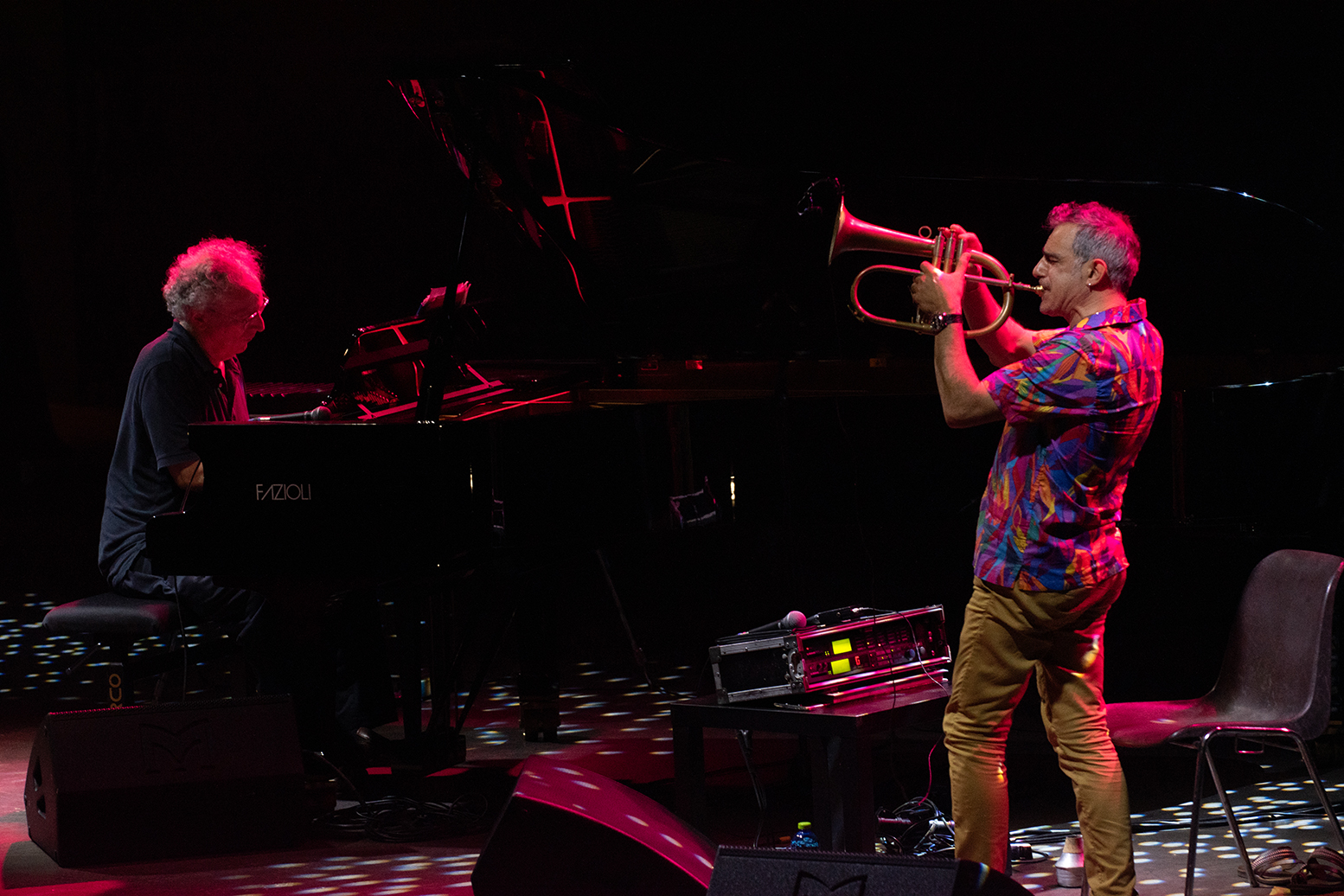
PAOLO FRESU AND URI CAINE
PAOLO FRESU
Trumpet
Flugelhorn
Effects
URI CAINE
Piano
Tuesday, November 3
DOORS | 7:00pm
CONCERT | 8:00PM
GLENN GOULD STUDIO
Canadian Broadcasting Centre (CBC)
250 Front St West | Toronto, ON
FREE ADMISSION | REGISTRATION REQUIRED
Seating for this event is limited and available on a first-come, first-served basis; we encourage early arrival.
Limit of two tickets per registrant. Please register using your full first and last name. Multiple registrations under the same name are not permitted. Duplicate registrations or registrations submitted without a complete name will be cancelled without notice.
Kindly note that, once the performance has begun, late arrivals will be seated discreetly and only where seating is available that allows entry without disrupting the performance.
REGISTRATION LINK COMING SOON
The Fresu-Caine duo is the story of the successful encounter between two great personalities of modern jazz. Together, they approach the game with surprising simplicity, managing perfectly to convey the feeling that drives this extraordinary music.
The encounter between these two musicians is one of the most interesting things that has happened in the world of jazz in recent years; Fresu’s lyrical and dreamy trumpet, his melancholic and dreamy timbre marries excellently with Uri Caine’s pianism, made up of a thousand quotations, from American song, to blues, from the most mainstream jazz to avant-garde to classical music, a genre that Caine has revised and corrected according to his personal parameters in many solo projects published in the last decade.
Two truly omnivorous artists in the most classic sense of the term. So much so that-when there has been an opportunity, their “concert” has instead turned into a series of concerts, spread over three or four days, each dedicated to a precise stylistic entourage of reference. At Umbria Jazz Winter, a few years ago, the duo was thus called upon to fill four separate evenings, each dedicated to a precise location. The first evening dedicated to the world of Baroque classical music, the second to jazz standards tout-court, the third to popular music in general (including rock and pop definitions), and the fourth to original pieces that the duo had previously recorded for their own works, collected in two discs released by Emi/Blue Note in past years.
Many speak of this duo as a small masterpiece of style, a project of vast horizons, the kind that puts you back at peace with the world. They are probably right to a fault.
Presented by the Embassy of Italy in Canada, the Istituto Italiano di Cultura Toronto and the Istituto Italiano di Cultura Montreal.
PAOLO FRESU
The village band and major international awards, the Sardinian countryside and records, the discovery of jazz and a thousand collaborations, the love of small things and Paris. There are very few people who can put together such a spate of elements and turn it into an incredible and fast stylistic growth. Paolo Fresu has succeeded precisely in a country like Italy where – for too long – jazz culture was as well-known as Shakespeare or the canvases of Matisse, where Louis Armstrong was little more than a freak of insane Sanremese showcases and Miles Davis discovered “black” and good well after his peak creative years.
The “magic” lies in the immense naturalness of a man who, like few others, was able to transport the deepest meaning of his precisely magical land into the most precious and freeing of arts.
At this point in his fortunate and long career, it is no longer necessary to enumerate recordings, awards and various experiences that have established him internationally and that make his music ecumenically beloved: within the sound of his trumpet is the sap that has given luster to the nouvelle vague of European jazz, the depth of a thought that is not only musical, the generosity that wants him in the right place at the right time but, above all, the inexhaustible passion that has always sustained him.
Paolo’s present is – as usual – swirling, worthy of the omnivorous and creative artist everyone recognizes in him.
Today (apart from a fascinating literary side that has resulted in the publication of some editorial works and the important delivery of Honorary Degrees from the University la Bicocca of Milan and the noble Berklee School of Music of New York) is made of his historic quintet approaching the four-decade mark of mutual esteem, but also that of the quartet “Devil” or of his new trio with two realities of contemporary jazz such as Dino Rubino and Marco Bardoscia or finally of the surprising “Heroes,” a tribute to David Bowie where he collaborates with the established names of Petra Magoni and Christian Meyer and with some of the most prominent of the Italian new wave jazz such as Francesco Diodati, Francesco Ponticelli and Filippo Vignato.
Not to be forgotten are important international collaborations such as the successful duo partnership with Uri Caine, or the great names of Carla Bley, Steve Swallow or Ralph Towner, which bridged the entry of Paolo’s name into the entourage of the celebrated and noble ECM label, for which other notable record works have been released.
His more current present sees him active, from a more foreign perspective, in a trio with Richard Galliano and Swedish pianist Jan Lundgren (“Mare Nostrum”) and in several new adventures with important names in the contemporary jazz entourage such as, among many others, Omar Sosa, Jaques Morelenbaum, Trilok Gurtu, Lars Danielsson, Eivind Aarset or Arild Andersen.
Interesting are then the projects with some big names of the Italian literary and theatrical world (Mariangela Gualtieri, Ascanio Celestini, Lella Costa, Stefano Benni, Alessandro Bergonzoni, Giuseppe Battiston), the frequentation of the theatrical world itself as a first performer thanks to the works produced by the Teatro Stabile of Bolzano among which the success of the plays “Tempo di Chet” and “Tango Macondo” as well as, finally, a new series of small but important collaborations with “intelligent” music of the Italian popular bangs or electronics.
Music for Cinema and “special projects” such as his extraordinary theatrical “a solo” close the circle together with the great little crazy adventure that led him to celebrate in 2011 his 50th birthday with 50 concerts, in 50 consecutive days, with 50 different formations and projects from day to day in 50 landscape masterpieces of his Sardinia. Not to be outdone, too, is the fine project dedicated instead to his important 60th birthday, aided and abetted by Bologna, which has now become, like Paris, one of his venues.
Also missing from the roll call is the important series of projects dedicated to different aspects of the “classical” world tout-court that, thanks to ad hoc works, is reserving beautiful surprises with musicians capable of “looking forward” or, finally, the beautiful new promotional work cha Paolo is carrying out towards many young lions of the contemporary jazz entourage through the possibilities offered to them thanks to his new label Tǔk Music built to look to the future and now become a reality of reference also at the international level.
URI CAINE
Uri Caine is one of the most intelligent and sensitive “architects” of today’s music, a brilliant alchemist, who composes in an original way starting again from the near past of great jazz as well as from the more distant past of classical music, capable of reinterpreting the repertoires of every era with intelligence, culture, humor. His jazz is a blend of classical, rock and electronic music. Growing up in Philadelphia, from the ages of twelve to sixteen he studied with the brilliant and underrated French pianist Bernard Peiffer, who while teaching him composition pushed him to rework pieces with an approach that proved basic in the development not only of the young student’s technique but of jazz theory. By the time he enrolled in college, he was already a major player in his city’s jazz scene: playing in jazz clubs, encountering the great masters who visited Philadelphia, and continuing to perfect his skills between courses in musicology and literature. Moving to New York, he began his career as a soloist. In 1992 he recorded his first record, Sphere Music.
In 2003 he was conductor for a memorable Venice Biennale, where he debuted with The Othello Syndrome, a work of variations loosely based on Giuseppe Verdi’s score that gave rise to the recording Winter and Winter nominated at the Grammy Awards in Los Angeles for best classical/crossover album of 2008 and the 2009 Echo Klassik award.
His projects in recent years include a composition on the horrors of war, commissioned by the Granada Festival, a musical work inspired by Goya’s paintings; a duo with John Zorn at the Vicenza Jazz Festival; a tour of the Diabelli Variations with the Orchestra Regionale Toscana and Orchestra Toscanini; Berio Project, commissioned by the Ravenna Festival in collaboration with Tempo Reale; the first performance of the Wagner and Venice program (the title of the Winter & Winter album, recorded live in Venice in 1997) at the German Potsdam Festival, a program that was replicated at the Ravello Festival; a commission for Suoni delle Dolomiti for string orchestra and piano; a new composition with the Arditti Quartet entitled Twelve Caprices; and Moonsongs, written to celebrate the 100th anniversary of the first performance of Schoenberg’s Pierrot Lunaire, performed at the Konzerthaus in Vienna and at the Teatro Comunale di Modena in 2013, featuring singer Cristina Zavalloni. Over the past decade, Uri has reached the Olympus of modern jazz, expanding his work with excellent projects and collaborations that increasingly establish him as one of the most active and intelligent contemporary pianists.
His collaboration with Paolo Fresu is among the most sought-after and appreciated on the jazz circuit while his discography, which is extensive and full of important works (some of which are recognized as real milestones), is indicated as a fundamental junction in contemporary musical history.